A ladder that fits the pool but fails at the deck, anchor, tread or corrosion check can become an expensive safety problem. By the end, you will be able to identify the right ladder type, record the measurements a supplier needs and compare materials, access claims, installation requirements and maintenance evidence.
Key takeaways
- Choose the access method from pool structure, deck layout and users.
- Measure wall height, deck clearance, water depth and fixing points.
- Match steps, rungs and handrails to users’ mobility and grip needs.
- Request steel-grade records, installation details and a service plan.
Choose the access method before choosing the ladder
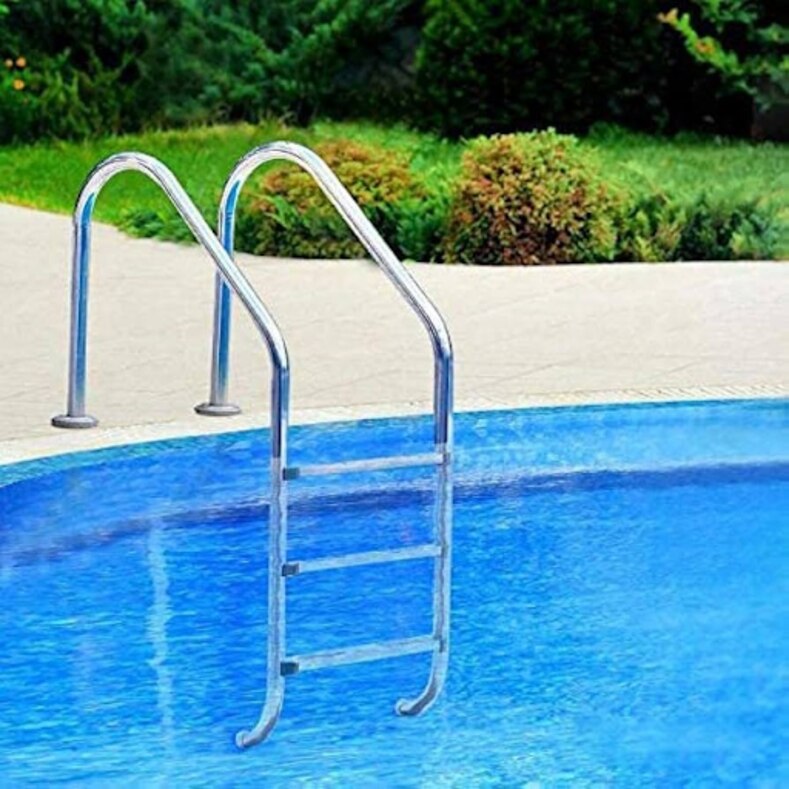
A raised pool needs a ladder that spans the pool wall and deck; a deck-level pool needs an in-pool ladder that starts at the deck edge and reaches the water. Choose the access method from that structure, the deck layout and the users before comparing finishes or tube sizes.
| Option | Best fit | Main limitation |
|---|---|---|
| Deck-mounted pool ladder | Deck-level pools with clear deck space | Uses deck area and needs sound anchors |
| Wall-mounted pool ladder | Raised or prefabricated pools with suitable wall framing | Requires strong wall attachment points |
| Recessed pool ladder | Pools where preserving deck space matters | Needs built-in recesses and compatible construction |
| Removable pool ladder | Controlled-access pools or seasonal use | Needs locking pins, set screws or another anti-rotation method |
| A-frame ladder | Many above-ground pools without a permanent deck | The outer legs can obstruct circulation space |
Use these removable pool ladder selection guidelines: define who will remove it, where it will be stored and how the locked ladder resists rotation under an eccentric load. Recessed and wall-mounted designs preserve more deck space, but only when the wall, shell or deck can accept the required sockets, flanges and anchors.
Treat accessibility as a separate decision.
Under the 2010 ADA Standards, an ordinary ladder is not automatically an accessible entrance: a covered pool with less than 300 linear feet of pool-wall perimeter generally needs one accessible entry, while a pool with 300 feet or more generally needs two, including at least one lift or sloped entry, subject to exceptions.
A transfer system applies to some pool types. For a lift, check the 16-to-19-inch seat height, 16-inch clear seat width and 300-pound capacity.
Match the ladder geometry to the pool structure and take every measurement
Record pool ladder measurements from finished surfaces before requesting a quotation or replacement. Measure the pool wall height and deck height from finished tile or coping, not unfinished concrete; a nominally matching width can still fail when leg angle, socket position or finished-deck height differs.
- Water depth at the entry point
- Clearance behind the ladder and its projection into the pool
- Handrail centre-to-centre and anchor spacing for the pool ladder
- Tube diameter, step width, leg angle and insertion depth
- Socket type, anchor-bolt pattern and deck thickness
Pool construction changes the fixing method and the risk of damage:
| Pool structure | Check before ordering | Consequence if ignored |
|---|---|---|
| Concrete deck | Slab thickness, reinforcement, edge distance and anchor-manufacturer limits | Cracked or thin concrete may not hold the embedment; use embedded sockets or surface flanges only when the slab supports them |
| Tiled pool | Tile thickness, coping height and grout-joint position | The ladder can sit high, bind or misalign if finished layers are omitted |
| Vinyl-lined pool | Liner-safe fittings and wall or frame construction | An unsuitable fitting can puncture or tear the liner |
| Fiberglass or prefabricated pool | Shell, frame or panel design and compatible hardware | Standard anchors can damage the structure or fail to transfer the load |
Draw a side view showing the ladder behind the deck and inside the pool. Confirm clear circulation around it and check that legs or rails will not strike coping, covers, automatic cleaners or nearby equipment.
Compare steps, rungs and handrails for the actual users
Count the steps required for the pool wall height, then check pool ladder step spacing in both vertical and horizontal directions. Closely spaced steps shorten the reach for children, older users and people with limited mobility; wide spacing can make the lowest step difficult to reach.
| Design | Footing and drainage | Main check |
|---|---|---|
| Flat pool ladder steps | More foot area and comfort for bare feet | Require drainage holes or channels to prevent standing water |
| Tubular rungs | Fast drainage and less debris collection | Check whether the narrower contact area feels stable when wet |
| Anti-slip pool steps | Defined tread pattern and treated edges | Request wet-slip test evidence; a polished handrail proves nothing about tread traction |
Confirm that handrails rise high enough to support entry and exit without making users twist. Specify rounded edges, capped tube ends, smooth weld transitions and rubber bumpers wherever the ladder touches a wall, liner or pool shell.
Ask the supplier to document these points:
- Tread texture, edge treatment and drainage design
- Replacement treads and end caps for commercial installations
- Cleaning compatibility and resistance to repeated brushing or chemical washing
- Handrail reach for the shortest and tallest regular users
A bright or mirror-polished rail is easy to clean but is not a safety specification. Judge the step surface separately, and reject any catalogue that shows appearance without stating spacing, wet-slip performance or replacement parts.
Verify stainless-steel grade, corrosion controls and compliance evidence
Demand a written material-and-compliance file, not a quotation that says only “stainless steel” or “marine grade.” An SS 304 pool ladder suits many conventional pool environments; an SS 316 pool ladder, including 316L, offers better chloride-pitting resistance because molybdenum is part of the alloy.
- Ask for the exact stainless-steel grade, surface finish, tube wall specification, weld procedure and fabrication drawing. Saltwater remains a chloride corrosion environment because a salt chlorinator converts dissolved sodium chloride into chlorine, and coastal air adds exposure.
- Require the supplier to state how passivation, post-weld cleaning, weld discoloration control and tube-end drainage are performed. SS 316 does not prevent pitting in warm, concentrated or poorly flushed water.
- Request a bill of materials identifying every wetted or embedded metal: fasteners, sockets, washers, anchors and escutcheons. Ask how the design isolates dissimilar metals, prevents carbon-steel tool contamination and stops chlorinated water collecting beneath covers.
- Ask for the applicable edition of the EN 13451-2 pool ladder standard, plus test reports or conformity documentation showing which model and configuration were assessed.
- Challenge any “ADA compliant” claim. Ask whether it refers to a lift, sloped entry or transfer system; stainless handrails alone do not establish compliance.
A buyer comparing a quotation from Samudra Industries can use these requests to separate a documented access specification from generic hardware language. A supplier that cannot provide the grade, process controls and evidence leaves you unable to compare service risk.
Related product
 | Swimming Pool Products Samudra Industries offers premium-quality Pool Ladders designed for safe, comfortable, and convenient access to swimming pools. View product → |
Confirm the complete installed assembly, fixing method and service plan
A complete quotation must cover the installed assembly, not just the ladder frame. Request a bill of materials for handrails, flanges, anchor sockets, escutcheon covers, rubber bumpers, isolation washers, locking pins or set screws, bolts, chemical anchors, deck plates and every other fixing.
- For a permanent ladder, record the anchor material, required embedment depth and installation torque. For a removable model, obtain the retention and removal procedure, then verify that the ladder cannot rotate under an eccentric load.
- Require the pool ladder load rating and its test configuration. Confirm whether the rating applies to one point, one step or the complete installed unit; tube diameter alone proves nothing about capacity.
- Inspect the deck before ordering. Cracked or thin concrete, inadequate reinforcement and insufficient edge distance can defeat a sound anchor design, so a generic recommendation cannot replace a site check.
- Require drawings showing flange positions, bolt patterns and minimum edge distances. Match them to the finished deck, socket type and existing reinforcement.
- For a public or commercial pool, obtain inspection intervals and a pool ladder maintenance checklist covering loose anchors, weld cracks, sharp edges, missing caps, corrosion staining, damaged treads and socket movement.
Pool ladder fixing hardware is not interchangeable with fountain or irrigation hardware. Continuous immersion and bather loading differ from spray exposure or intermittent high-flow service, so confirm metals, seals and design ratings for the actual duty.
Frequently asked questions
How do I choose the right pool access method?
Choose a raised-pool ladder when it must span the pool wall and deck. Choose an in-pool ladder for a deck-level pool when access begins at the deck edge.
Which measurements should I take before ordering a pool ladder?
Measure the pool wall height, deck height and clearance, water depth, fixing-point positions, available deck space and the required ladder reach.
How should I compare pool steps, rungs and handrails?
Compare tread width, rung spacing, surface grip, handrail diameter and user mobility needs. Select a design that users can enter, exit and hold securely.
What evidence should a pool ladder supplier provide?
Ask for the stainless-steel grade, corrosion-control details, load information, compliance documents and installation instructions.
What should a complete pool ladder quotation include?
Confirm the ladder, handrails, steps or rungs, anchors, fasteners, gaskets, fixing method, installation scope, warranty and service plan.